
Clients ask me about acupuncture and chiropractic care more often than any other integrative modality. The honest answer is that the evidence base is uneven. Some applications of veterinary acupuncture have strong clinical trial support. Most claims made for canine chiropractic rest on case series and mechanism hypotheses rather than randomized trials. Sorting through the research is worth the effort because, correctly applied, these modalities can meaningfully reduce pain and improve function in dogs with chronic joint disease — especially dogs for whom pharmaceutical options are limited by concurrent renal, hepatic, or gastrointestinal disease.
I do not practice either modality myself. I refer clients to credentialed practitioners, and I review the published literature regularly so I can give clients an honest read on what to expect. This article is the condensed version of the conversations I have with clients considering these therapies.
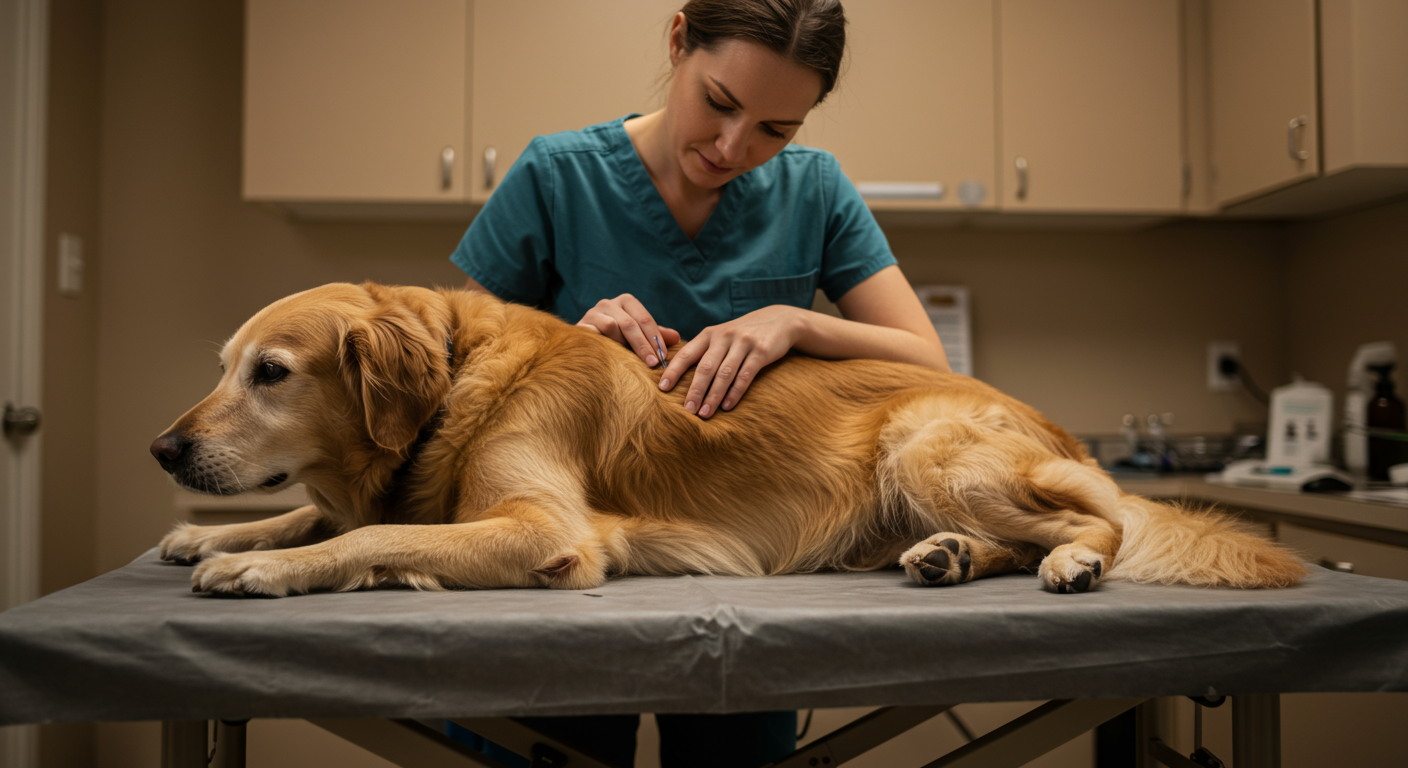
Veterinary Acupuncture: What the Research Shows
Veterinary acupuncture has the stronger evidence base of the two. Studies published in the Journal of the American Veterinary Medical Association, Frontiers in Veterinary Science, and Veterinary Anaesthesia and Analgesia over the past fifteen years have examined acupuncture for osteoarthritis pain, hip dysplasia, cervical and thoracolumbar disc disease, and post-surgical recovery. The methodological quality of these studies varies, but the aggregate picture is consistent.
For chronic osteoarthritis pain, a 2007 randomized controlled trial by Hielm-Björkman and colleagues found that dogs receiving weekly acupuncture sessions showed statistically significant improvements in pain scores and weight-bearing on force plate measurements compared to controls. A 2020 systematic review in Animals concluded that acupuncture provided moderate analgesic benefit comparable to low-dose NSAIDs in dogs with osteoarthritis, with no significant adverse events reported across the reviewed studies. The mechanism is partly understood — stimulation of acupuncture points releases endogenous opioids and modulates descending pain pathways — and partly still being worked out.
Best-Supported Indications
- Chronic osteoarthritis pain. Particularly for hip, elbow, and stifle OA where pharmaceutical options are limited by side effects.
- Intervertebral disc disease recovery. Adjunct to conservative management or post-surgical rehab.
- Myofascial pain syndromes. Trigger point release in chronically compensating muscles.
- Post-surgical analgesia. Documented reduction in opioid requirement in some orthopedic surgeries.
Typical protocols involve weekly sessions for 4 to 6 weeks, followed by maintenance sessions every 2 to 4 weeks. Session costs range from $75 to $175 in most regions. Most dogs tolerate acupuncture well — needles are fine (typically 0.16 to 0.25 mm gauge), and reactions beyond mild local tenderness are uncommon.
The IVAS Credential and Why It Matters
Veterinary acupuncture should be performed by veterinarians who have completed formal training through the International Veterinary Acupuncture Society (IVAS), the Chi Institute, or equivalent programs. These courses require approximately 150 to 200 hours of instruction plus a case log and a certification examination. A veterinarian with the CVA (Certified Veterinary Acupuncturist) or FAAVA (Fellow of the American Academy of Veterinary Acupuncture) credential has completed documented training. Lay acupuncturists without veterinary medical training are not equivalent and should not be treating dogs.
Veterinary Chiropractic: A More Complicated Picture
The evidence base for canine chiropractic, formally known as veterinary spinal manipulation therapy, is substantially thinner. Most published work consists of case series, biomechanical modeling, and mechanism hypotheses. Randomized controlled trials in dogs are rare. A 2017 review in the Journal of Veterinary Medical Science identified only a handful of controlled studies, most with small sample sizes and methodological limitations.
This does not mean chiropractic is ineffective. It means the clinical evidence has not yet caught up with the practice. For specific indications — particularly sacroiliac dysfunction and compensatory spinal stiffness secondary to hind-limb orthopedic disease — practitioners and many owners report meaningful improvements. A 2019 observational study of sporting dogs receiving chiropractic care reported improved range of motion and handler-assessed performance, though the study lacked a control group.
Where Chiropractic Appears Most Useful
The most defensible applications of veterinary chiropractic are:
- Compensatory spinal dysfunction secondary to chronic hip, stifle, or elbow joint disease
- Sporting-dog maintenance in agility, flyball, dock diving, and herding dogs with repetitive high-impact activity
- Post-rehabilitation maintenance after orthopedic surgery when compensatory patterns persist beyond the rehab window
Chiropractic is not a substitute for orthopedic diagnosis. A dog with unexplained lameness needs radiographs and an orthopedic examination, not chiropractic manipulation. Chiropractic-first approaches in acute lameness can delay the diagnosis of disc disease, cruciate tears, or neoplasia with serious consequences. This is why referral through a primary veterinarian is the safest pathway.
Credentialing for Chiropractic
Veterinary chiropractors should hold certification through the American Veterinary Chiropractic Association (AVCA) or the International Veterinary Chiropractic Association (IVCA). Both require either a veterinary degree or a human chiropractic degree plus a postgraduate animal chiropractic course of 200 to 300 hours. In most U.S. states, chiropractic care on animals must be performed by or under the supervision of a licensed veterinarian. State veterinary practice acts govern the specifics.
Combining Modalities With Conventional Care
Integrative modalities work best as adjuncts, not replacements. The dogs that do best on acupuncture or chiropractic are dogs whose owners maintain a complete care plan — appropriate diagnostic workup, evidence-based pharmaceutical management where indicated, structured physical therapy and hydrotherapy, nutritional support, and appropriate supplementation. Integrative modalities layered on a strong foundation produce meaningful incremental improvement. Integrative modalities used as the sole approach often disappoint.
For dogs with established osteoarthritis, combining acupuncture with an anti-inflammatory whole-food diet and targeted joint supplementation frequently produces a larger cumulative benefit than any single intervention alone. I have dozens of senior clients whose owners credit the combination with keeping them comfortable and mobile well past the point where pharmaceutical monotherapy was failing.
Red Flags
Several practitioner behaviors should make owners suspicious. Any integrative practitioner who claims to cure osteoarthritis, who refuses to collaborate with the primary veterinarian, who recommends indefinite twice-weekly sessions without measurable progress benchmarks, or who discourages evidence-based care is not practicing responsibly. Responsible integrative practitioners work within a team, document outcomes with objective measurements, and taper to maintenance frequency as the dog stabilizes.